New York Roads - NY 30
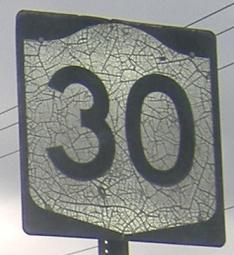

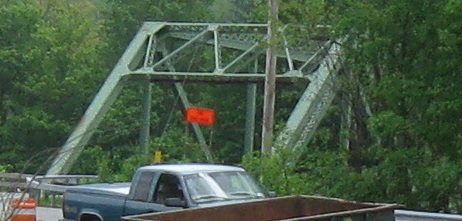
Crossing the East Branch of the Delaware River, seen from the intersection with NY 28 that you'll see in the other direction below from Michael Summa. In the back of this photo is a new-style NY 30 shield that contrasts poorly with the old style in the foreground.

The Pepacton Reservoir at dawn during a warm winter. It supplies ¼ of New York City's drinking water via a series of reservoirs and aqueducts.

The Reservoir flooded out four small settlements, with a total of about 1,000 people in them. They were moved out of the way first.

Courtesy Michael Summa, SB at NY 23 and then NY 28 in 1975. The letters and numbers on the green signs may look subtly different - the notched 2 being the most obvious - and that's NY's old font. Michael called it the "Thruway font", but clearly this has nothing to do with the Thruway. The STOP sign is on what are known as Z bars, a type of support system usually used for route shields (they're there in the background of that photo too).

In Margaretville, Main St. SB at Fair St. just southwest of the NY 28 junction, again courtesy Michael Summa from 1975, followed by an even older sign photographed in the present day by John Krakoff. I know the first sign uses an older font, but the 3 and 8 look like they were flipped vertically. I checked it out - it's just that the loops are identical size, whereas in most fonts the top loops are smaller.

Northbound and southbound, respectively. NY 990V is by far the best signed of the routes that are supposed to remain secret, with a detour sign on NY 23 at one point and full signage in all directions at NY 30. Here, especially from the NB arrow, you can see that this route was signed many years ago and the signs have persisted. No new error is this.

Take a bite out of sign! Take an even bigger bite by clicking for closeup courtesy John Krakoff.

They sure don't make 'em this way anymore - not connecting to dry land, that is. The Blenheim Bridge, built in 1854, is the longest single-span covered bridge in the world, at 232 feet long and 210 feet suspended over Schoharie Creek. The reason it doesn't connect to anything at the western end is because the bridge was extended in 1869 to cover a new wider channel that was the result of a heavy spring thaw, possibly combined with rainfall. That extension was subsequently replaced by an iron extension, which simply doesn't have the life of a wooden bridge. When the bridge was bypassed in 1931 on an alignment closer to the current NY 30 bridge, the covered part was kept as a historical landmark.
"Drive" the Blenheim Bridge eastbound in this video

Yup, there's still more to this page.

SB on old NY 30 courtesy John Krakoff.
NB courtesy Doug Kerr at I-90 Exit 27.

Minaville St. SB at the NY 30 SB offramp in South Amsterdam, courtesy John Krakoff.

Across the Erie Canal in Amsterdam, NY 30 NB at a pretty cool interchange with NY 5 and 67 with some cool signage. The NB-EB ramp, for example, actually folds in on the left side of NY 5 eastbound traffic, which is what you see in the second photo. NY 5 WB is another block to the north, and the remainder of the second photo (there's one more sign to the right) is on the NY 5 page, linked below.

Southbound, on the opposite side of the overhead gantry from the first photo immediately above.

No, no no. Northbound in Amsterdam, the problem is that the font on this is B instead of D.

The old four-way signal at Vandyke Ave. is actually not much of a treasure, because if you turn left (from heading north), you get the trapezoidal YIELD sign in the second photo, which is just barely too new to be yellow.
Fort Rd. in Schoharie, old NY 30
Split onto NY 30A
Onto NY 28
Onto NY 23
Onto NY 990V
Onto I-90, the New York Thruway
Onto NY 5
Back to NY Roads
Back to Roads